Different Pasta Shapes: Names, Sauces and What to Order
In short
- Different pasta shapes fall into five families: long strands, tubes, twists and small shapes, stuffed pasta, and sheets.
- The name often tells you the size: -ini and -etti mean smaller, -oni means bigger, and rigate means ridged.
- Thin, smooth sauces suit thin strands. Chunky or creamy sauces suit tubes, twists and shells.
- To choose a shape off a menu, use the fork test: twirl, spear, spoon or cut, then match it to where you’re eating.

A pasta menu can read like a vocabulary test. Pappardelle, paccheri, orecchiette, cavatappi. You know you like pasta, but the names don’t tell you what will arrive on the plate.
You don’t need to memorize them. Nearly every shape belongs to one of five families, and each family eats in its own way. Once you know the family, you can guess the sauce and decide whether it suits tonight.
What are the different pasta shapes called?
Different pasta shapes are easiest to learn in five families. They are long strands like spaghetti, tubes like penne, twists and small shapes like fusilli, stuffed pasta like ravioli, and sheets like lasagna. Each family below lists the common names, what the shape looks like and how it eats.
Long strands: you twirl them
- Spaghetti. Long, round and medium-thin. The default for tomato sauces and carbonara.
- Angel hair (capellini). The thinnest common strand. Best with light olive oil sauces or in broth.
- Linguine. Spaghetti pressed slightly flat. Classic with clam sauce or pesto.
- Fettuccine. Flat ribbons, wider than linguine. The usual partner for Alfredo.
- Tagliatelle. Flat egg ribbons, close to fettuccine. In Bologna it’s the pasta for meat ragù.
- Pappardelle. The widest ribbons, made for rich, slow-cooked meat sauces.
- Bucatini. Thick spaghetti with a hole running through the middle. Often served all’amatriciana.
Tubes: you spear them
- Penne. Short tubes cut on a slant, smooth or ridged. Seen with vodka sauce and arrabbiata.
- Rigatoni. Wide, ridged tubes with straight ends. They hold meat sauce inside and out.
- Ziti. Smooth tubes with straight ends. In the US you’ll mostly meet it as baked ziti.
- Paccheri. Very wide, smooth tubes. Often served with seafood or a chunky ragù.
- Elbow macaroni. Small curved tubes, the classic shape for mac and cheese.
Twists and small shapes: you spear or spoon them
- Fusilli. Spirals that trap pesto and chunky sauce in their grooves.
- Rotini. A tighter, shorter spiral. Common in pasta salads.
- Cavatappi. A hollow corkscrew tube. Many restaurants use it for mac and cheese.
- Gemelli. Looks like two strands twisted together. Firm and chewy.
- Farfalle. Bow ties. The name means butterflies.
- Orecchiette. “Little ears,” small cupped discs. In Puglia they come with broccoli rabe and sausage.
- Conchiglie. Shells that scoop up sauce. The jumbo size gets stuffed and baked.
- Orzo. Shaped like grains of rice. Used in soups and salads.
- Ditalini. Tiny short tubes, mostly for soup.
Stuffed pasta: you cut or pop them
- Ravioli. Square or round pillows with a filling of cheese, meat or vegetables.
- Tortellini. Small filled rings. Served in broth, or with butter or cream.
- Agnolotti. Small pinched pillows from Piedmont, often in butter sauce.
Sheets and big shells: you cut them
- Lasagna. Wide flat sheets layered with sauce and cheese, then baked.
- Cannelloni or manicotti. Large tubes stuffed with ricotta or meat, then baked in sauce.
- Gnocchi. Not strictly pasta, since they’re soft dumplings, usually potato and flour. Menus list them with the pasta.
How do I tell pasta shapes apart on a menu?
To tell pasta shapes apart on a menu, read the ending of the name. Italian endings like -ini and -etti mean a smaller version, and -oni means a bigger one. Rigate means ridged and lisce means smooth. Spaghettini is thin spaghetti, and conchiglioni are jumbo shells.
The ending gets you most of the way. If the name is new, the sauce next to it is the next clue. A long name over a meat ragù is likely a ribbon. A short name in a baked dish is likely a tube.
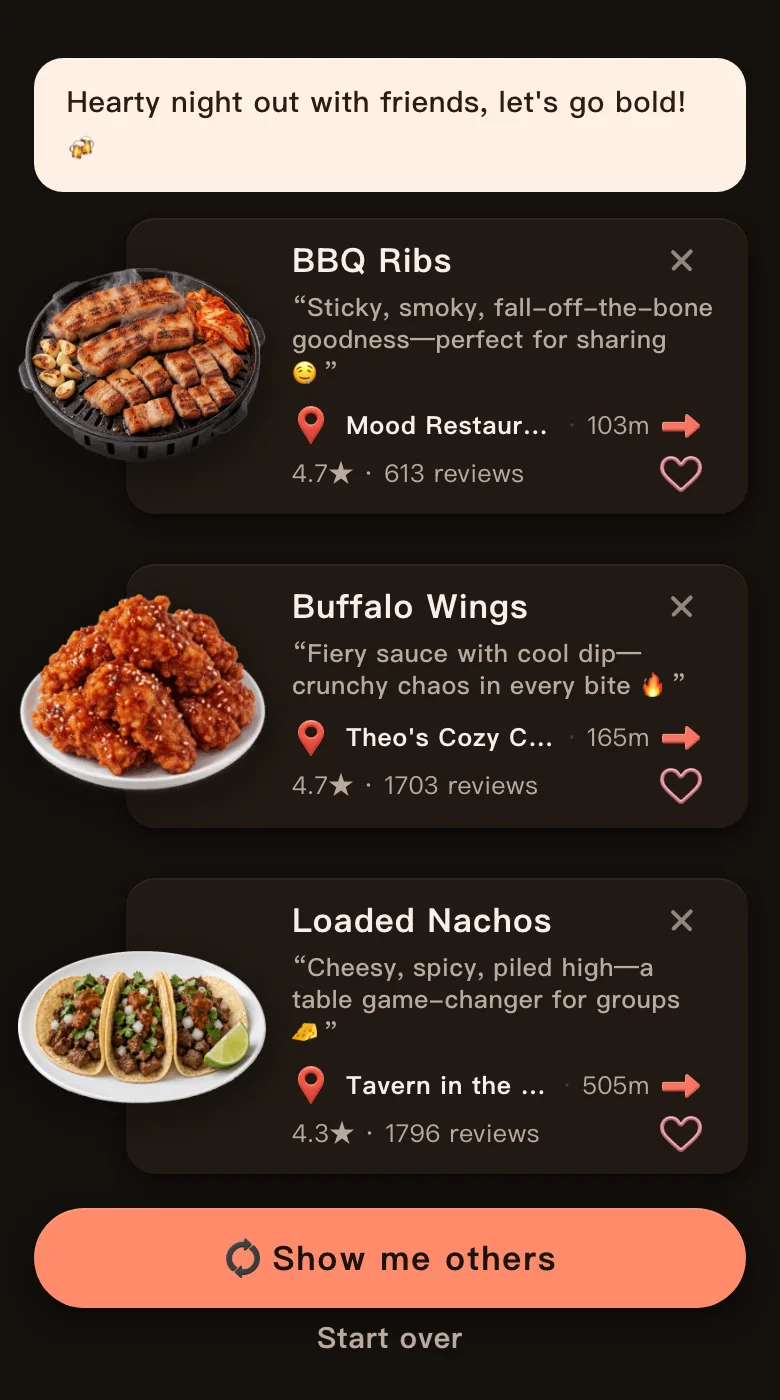
I ran Today’s Mealow, my own project, from Boston’s North End and asked for a bold Western dinner with friends. The cat came back with ribs, wings and loaded nachos, all food you pass around a table. No pasta at all. When I switched the company answer to “On a date,” a creamy chicken pasta made the three both times I tried. Neither card named the shape, which is where the fork test below comes in.
Which pasta shape goes with which sauce?
Pasta shapes match sauces by grip. Thin, smooth sauces like olive oil, butter or a light tomato sauce suit long thin strands. Wide ribbons carry rich meat sauces. Tubes, spirals and shells hold chunky or creamy sauces in their hollows and grooves. Ridged shapes grip more sauce than smooth ones.
- Oil, butter or light tomato. Spaghetti, angel hair, linguine.
- Cream and cheese. Fettuccine, tortellini, and for mac and cheese, elbows, shells or cavatappi.
- Meat ragù. Tagliatelle, pappardelle, rigatoni.
- Pesto. Linguine, fusilli, gemelli.
- Chunky vegetables or sausage. Orecchiette, shells, penne.
- Broth. Tortellini, orzo, ditalini.
Restaurants don’t always follow these pairings, and that’s fine. The list is for guessing what a dish will be like when the menu only gives you the sauce, or only the shape.
Which pasta shape should I order?
To choose a pasta shape when ordering, use the fork test. Each shape is eaten one of four ways: twirled, speared, spooned or cut. Pick the way that suits where you’re eating, then choose the sauce. Spearing is the tidiest, twirling the messiest, and cutting takes a knife.
- On a date or in a light shirt. Choose a speared shape: penne, rigatoni, fusilli, farfalle. Long strands flick sauce, and a slurp mid-sentence is hard to avoid.
- Sharing with a group. Short shapes or a baked dish. Tubes and shells spoon onto a plate cleanly, and a tray of baked ziti or lasagna cuts into portions.
- Ordering in. Short shapes over long ones. Strands tend to clump in the box, while tubes and spirals hold their sauce. For the rest of what travels well, see the takeout rule for dinner.
- Eating slowly, with time to enjoy it. This is the night for long ribbons, like pappardelle in a meat sauce. Twirling is part of the fun when nobody’s rushing you.
Here’s the test on my date-night pick. A creamy chicken pasta with no shape on the card could be fettuccine or penne. On a date, I’d ask the server which shape it comes in. If it’s a ribbon, I’d order it anyway and twirl slowly. If the kitchen can do it with penne, I’d ask for that.
What is the spiral pasta called?
Spiral pasta usually goes by one of three names. Fusilli is the classic spiral, rotini is a tighter and shorter spiral, and cavatappi is a hollow corkscrew tube. In US grocery stores, fusilli and rotini are often sold as near twins, and recipes swap them freely.
All three catch sauce in their curves, which makes them good with pesto and chunky vegetable sauces. Rotini is the usual pasta salad shape because the tight spiral holds dressing. Cavatappi is the one you’ll see on restaurant mac and cheese, since the tube fills with cheese sauce.

Not sure it’s a pasta night at all? Today’s Mealow asks six questions, from the cuisine you want to what you skip, and picks 3 dishes from real places near you, each with a one-line reason.
Pick tonight’s dishWhat if I can’t choose between two types of pasta?
If you can’t choose between two types of pasta, compare how each one eats rather than how it sounds. If both pass the fork test for tonight, take the one with the sauce you’d miss more. If even that ties, let a coin decide and order the other one next time.
Sometimes the real question is bigger than the shape. If you’re torn between pasta and a different cuisine entirely, a random cuisine pick can break the tie. And if you’re cooking rather than ordering, the kitchen test tells you whether the dish you have in mind is one to make yourself.
What else do people ask about pasta shapes?
How many types of pasta are there?
There are far more pasta shapes than any one menu lists, and the same shape can go by different names from region to region. The five families cover the shapes you’ll meet on most menus.
What’s the difference between penne and ziti?
Penne are cut on a slant and are often ridged. Ziti are cut straight across and are usually smooth. Both work in baked pasta dishes and with chunky tomato sauces.
Is gnocchi a type of pasta?
Gnocchi are dumplings, usually made from potato and flour, so strictly they aren’t pasta. Menus list them alongside pasta, and they eat like a soft short shape.
What pasta shape is best for mac and cheese?
Shapes with hollows or cups hold cheese sauce best: elbow macaroni, small shells and cavatappi. Each bite carries sauce inside the pasta as well as on it.
What is the smallest pasta shape?
The smallest common pasta shapes are soup pastas like orzo, ditalini and acini di pepe, which means peppercorns. They’re eaten with a spoon, usually in broth.