What Should I Eat at Home? Dish First, Then Cook or Order
In short
- Eating at home has two routes: cook it yourself, or have it delivered. Pick the dish before you pick the route.
- Name the dish with three answers: a style, a flavor and anything you skip.
- Then run the kitchen test on that dish: do I have the base, can my kitchen do the key step, and would I pick my version over theirs?
- Pass all three and you cook. Fail one and you order, or cook an easy dish in the same style and flavor.

I build Today’s Mealow, and one of the options on its home screen is called “Staying in.” I tested it for this post. It doesn’t hand you a recipe. It finds dishes you can have delivered from places nearby.
That is one honest answer to “what should I eat at home?” The other is your own kitchen. The test below showed me that the useful move is to settle the dish first. Whether you cook it or order it comes second.
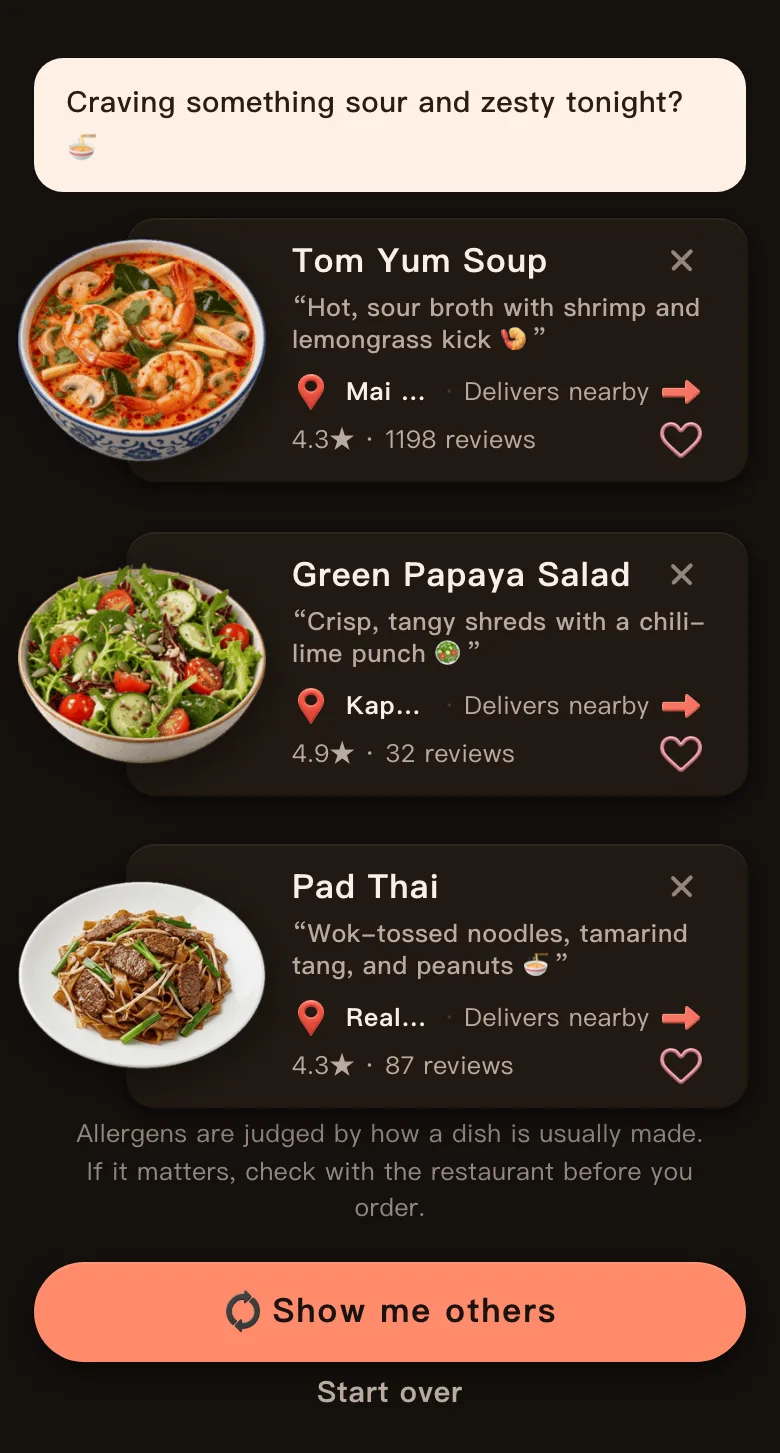
I set the location to downtown Austin, tapped Staying in, and answered Southeast Asian, Sour, and Cilantro as the thing I skip. The cat came back with “Craving something sour and zesty tonight?” and three Thai dishes, all marked “Delivers nearby”: tom yum soup, green papaya salad and pad thai. Each had a one-line reason, like “Crisp, tangy shreds with a chili-lime punch” for the salad. My next question was the one this post is about: could I make any of these myself tonight?
What does eating at home really mean tonight?
Eating at home means one of two routes: you cook the food, or someone else’s kitchen sends it to your door. Both end with you on your own sofa. The dish you want decides which route makes sense, so choose the dish first and the route second.
Starting with the route is how evenings stall. “Should I cook or order?” has no answer until you know what you’re hungry for. Once you know you want something sour and Thai, the question gets small: can my kitchen make that, or can’t it?
How do I name a dish before I choose to cook or order?
To name a dish for eating at home, give three answers: the style of food, the flavor you want, and anything you skip. Style narrows the kitchen, flavor narrows the dish, and the skip list removes what you won’t eat. Together they usually point at one or two dishes.
- Style. Chinese, Japanese, Korean, Southeast Asian, Western, fusion or something light. If nothing pulls you, pick the style you haven’t had for the longest.
- Flavor. Spicy, light, sweet, bold or sour. One word is enough. “Sour” took my Austin test straight to lime, tamarind and lemongrass.
- What you skip. Seafood, beef, nuts, dairy, chili, cilantro, whatever it is tonight. Say it before you look at anything, so nothing you won’t eat makes the shortlist.
Those are the same answers the Staying in option asked me for, and they work just as well at your own stove. Style plus flavor names the dish. The skip answer edits it: with cilantro out, a Thai dish I cook at home gets mint or basil instead.
Should I cook this dish or have it delivered?
To decide whether to cook a dish or have it delivered, run the kitchen test. Check that you have its base ingredients, that your kitchen can do its key step, and that you’d pick your version over a restaurant’s tonight. Cook it if all three pass. Order it if any one fails.
- Do I have the base? The noodles, rice, eggs or main ingredient the dish is built on. One missing item means a shop run, which turns a quick meal into an errand.
- Can my kitchen do the key step? Some dishes are their technique: deep-frying, a very hot wok, a broth that simmers all afternoon, pounding in a mortar. If the dish depends on that step and you can’t do it, order it.
- Would I pick my version over theirs? Be honest. A home pad thai can be good, but if tonight you want the one a Thai kitchen makes, yours will feel like second place.
Here’s how my three Austin dishes did. Tom yum soup failed the first check: I don’t keep lemongrass, galangal or lime leaves. Green papaya salad failed the first two, since it needs green papaya and a mortar. Pad thai passed the first check, since rice noodles and eggs are in my cupboard, but failed the third. All three were orders, which is what the Staying in option suggests anyway.
On another night the same test sends you to the stove. If you’d answered Japanese and Light, chicken and egg over rice passes all three checks in most kitchens. The base is rice, eggs, an onion and soy sauce, and the only step is a gentle simmer. On a quiet night I’d rather have my own bowl than wait for one.
What are easy foods to make at home for each style?
Easy foods to make at home are dishes that pass the kitchen test in an ordinary kitchen. Each needs a short list of staples and one pan or pot. Below they’re grouped by style with their flavor in brackets, so your first two answers point straight at a line.
Chinese
- Scallion oil noodles (bold).
- Soy-glazed chicken thighs with garlic bok choy over rice (bold).
- Hot and sour soup with tofu and egg ribbons (sour, spicy).
Japanese
- Oyakodon, chicken and egg simmered with onion over rice (light).
- Yaki udon with cabbage and pork (bold).
- Salmon over rice with furikake and sliced cucumber (light).
Korean
- Kimchi jjigae, a kimchi and pork stew (spicy, sour).
- Tteokbokki from a pack of rice cakes (spicy, sweet).
- Gyeran-mari, a rolled omelet, with rice and kimchi on the side (light).
Southeast Asian
- Thai basil chicken over rice with a fried egg (spicy).
- Vietnamese-style noodle salad: rice vermicelli, herbs and a lime and fish sauce dressing (sour).
- Chicken satay under the broiler with peanut sauce (sweet).
Western
- Baked ziti (bold).
- Lemon butter chicken cutlets with green beans (sour).
- Smash burgers in a skillet (bold).
Fusion
- Gochujang butter noodles (spicy).
- Bulgogi-style beef tacos with quick-pickled onion (sweet).
- Miso butter pasta with mushrooms (bold).
Light
- Baked cod with cherry tomatoes and olives (sour).
- Sheet-pan tofu and broccoli with ginger and soy (light).
- Lemony white bean soup with greens (sour, light).
Check the skip answer against your line before you start. The satay has peanuts, the tacos are beef, and the tofu and miso dishes are soy. For no-recipe dinners built from the freezer and cupboard, the lazy dinners list covers that side.

Dish failed the kitchen test? On Today’s Mealow’s home screen, tap Staying in, give a style, a flavor and anything you skip, and the cat picks 3 dishes from real places that deliver nearby, each with a one-line reason.
Order in with the catWhat if the dish I want fails the kitchen test?
If the dish you want fails the kitchen test, you have two moves. Order that exact dish, or keep your style and flavor answers and cook a different dish that passes. I call the second move a home twin: a different dish that gives you the same kind of meal.
My Austin answers were Southeast Asian and Sour. The tom yum and the papaya salad were out of reach in my kitchen. The Vietnamese-style noodle salad from the list is not: it passes all three checks if you keep vermicelli, limes and fish sauce. With mint in place of cilantro, it fits the skip answer as well as the other two.
Pick the twin when what you wanted was the flavor. Order the original when you wanted that exact dish. If tom yum is the thing you keep thinking about, a noodle salad won’t settle it.
What are easy meals at home for one?
Easy meals at home for one are dishes that cook as a single portion without leftovers you’ll resent: rice bowls, noodles and egg dishes. From the style list, oyakodon, scallion oil noodles, yaki udon and gyeran-mari all scale down to one plate without fuss.
Cooking for one also changes the third check. Nobody else has to like your version, so it wins more often. Delivery for one changes too: a single dish from a place you like costs you nothing to wash. When you’re eating alone and the fridge looks thin, cooking a small home twin is usually easier than doing a full shop.
If you’re cooking at home in the middle of the day instead, the lunch at home guide sizes the meal to your afternoon. When no style pulls you either way, try a veto round before you give the three answers.
What else do people ask about eating at home?
What should I cook at home tonight if I keep making the same dish?
Change the style answer and let the dish follow. Work through the styles in order, one per night you cook, and the flavor answer still lets you lean on what you like. Or put the styles on a food wheel and spin.
Is cooking at home cheaper than ordering in?
Cooking at home is usually cheaper when the dish passes the first check and you already have the base. A dish that needs a special shop for ingredients you’ll use once can cost more than ordering it.
Can I make restaurant dishes like tom yum soup at home?
Restaurant dishes like tom yum can be made at home with a jar of paste and a few fresh items, but the result tastes different. Cook it when close enough is fine. Order it when you want the real thing.
What can I eat at home right now if I’m starving?
When you’re starving, run only the first check of the kitchen test: what can I make from what’s already here? Eggs over rice or scallion oil noodles both start from the cupboard. Save the full test for a night when you can wait.