What to Order at a Restaurant: A Menu-in-Hand Checklist
In short
- To decide what to order at a restaurant, run the seven-point menu-in-hand checklist before the server comes back.
- Start with what you can’t eat, then read the menu for kitchen clues: a cooking tool it names and an ingredient it repeats.
- Then check the room and your table, and settle your last two dishes with one question to the server.
- Say your order once and close the menu.

You asked for another minute with the menu, and the server walked away. The menu runs to two pages, every dish sounds fine, and your friends have already closed theirs.
The menu can help more than it seems. Its wording shows what equipment the kitchen has and which ingredients it keeps plenty of, and the tables around you show what the room is eating tonight. The checklist below reads those clues one line at a time, while the menu is still in your hands.
How do you decide what to order at a restaurant?
To decide what to order at a restaurant, run the menu-in-hand checklist. Rule out what you can’t eat, then look for the kitchen’s clues: a cooking tool the menu names, an ingredient it repeats, and the dish you see leaving the kitchen. Fit the order to your table, then say it once.
Comparing every dish against every other dish is what stalls you. Each line of the checklist throws a few dishes out, and you choose from whatever is left. Choosing the place is a separate job, covered in the guide to picking a restaurant. This one starts once you’re seated.
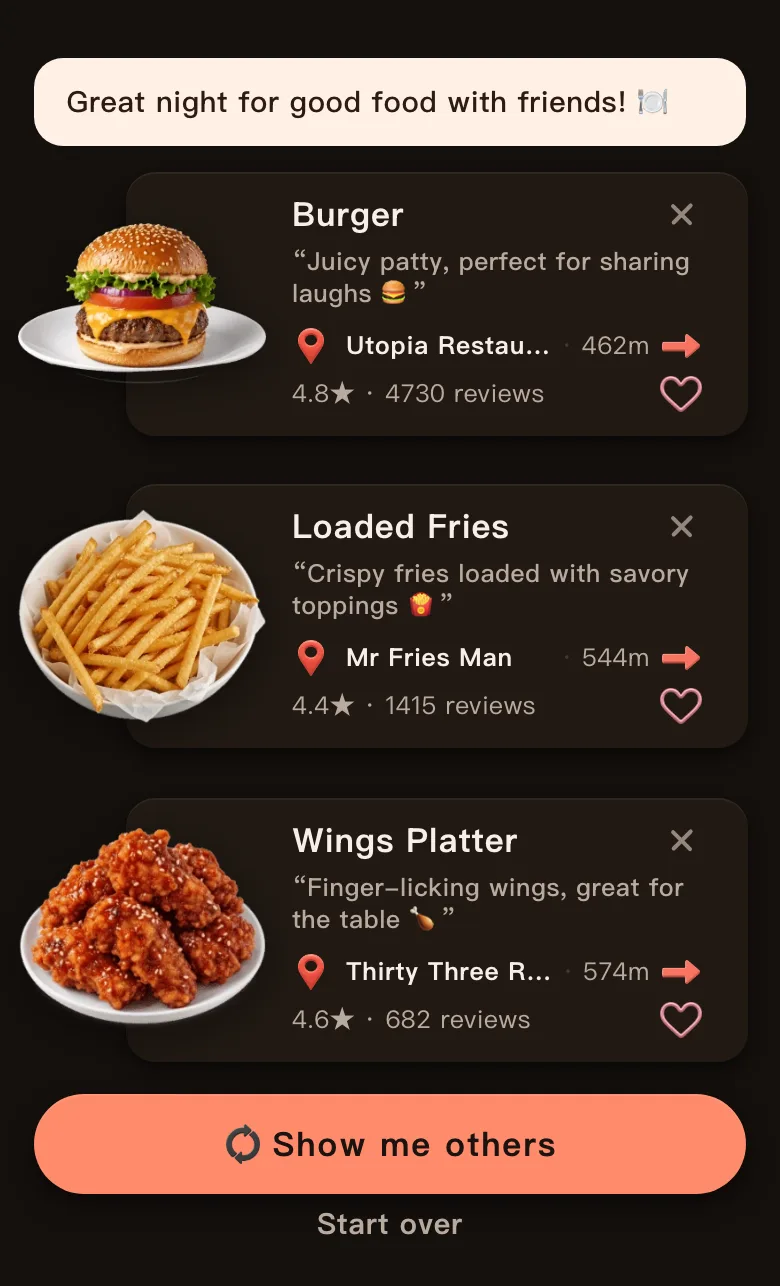
Today’s Mealow is my app. For this post I pointed it at downtown Atlanta and asked for dinner with friends, any cuisine, any flavor. The cat said “Great night for good food with friends!” and picked a burger, loaded fries and a wings platter, each from a different place nearby.
Two of the three were plates for the middle of the table. The wings card even said “great for the table.” That’s the fifth check below, done before I’d opened a menu. If I were going, I’d head to the wings place and choose my own plate there.
What’s on the menu-in-hand checklist?
The menu-in-hand checklist has seven checks. Rule out what you can’t eat, then look for a cooking tool the menu names, an ingredient it repeats and the dish leaving the kitchen. Fit the order to your table, settle your last two with one question, and say it once.
- ☐ Is there anything here I can’t eat? Tell your server first, so nothing you pick has to go back.
- ☐ Does the menu name a cooking tool? Words like wood-fired, smoked, charcoal, tandoor or wok point to the equipment the place is built around, and those dishes are hard to copy at home.
- ☐ Which ingredient keeps showing up? An ingredient that appears in three or four dishes is one the kitchen has plenty of and cooks often.
- ☐ What’s coming out of the kitchen? Glance at the nearby tables, because a dish you see go past twice is one the room trusts.
- ☐ Who am I eating with? Alone, order a plate that’s all yours; with friends, add one plate for the middle.
- ☐ Am I down to two dishes? Ask the server “Which of these two would you get?” and take the answer.
- ☐ Have I said it once? Give the dish and its one answer, using the one-choice rule, then close the menu.
Checks two and three do the most work. A menu never labels its best dish, but the words it repeats point you there.
How does the checklist work on a typical menu?
On a typical menu, the checklist cuts a full page down to one or two dishes within a few checks. Here’s a run on a smokehouse-style menu, for someone who skips shellfish and is eating with two friends. Each check removes dishes until the order is obvious.
The menu has smoked wings, fried pickles and burrata with grilled peaches to start. The mains are a smoked half chicken with peach glaze, a brisket sandwich, shrimp and grits, a cheeseburger, pasta primavera and a Caesar salad. Peach cobbler closes the dessert list.
- Can’t eat: shellfish. You tell the server, and the shrimp and grits is out.
- Cooking tool: “smoked” sits on the wings, the half chicken and the brisket. That’s the smoker, so the burger, pasta and salad drop back.
- Repeated ingredient: peaches turn up three times. The half chicken now has two clues.
- The room: a brisket sandwich goes past twice. It’s half chicken against brisket.
- Your table: three of you, so the smoked wings go in the middle.
- Last two: you ask which one the server would get. Say they answer the half chicken.
- Say it once: “Smoked wings for the table, and the half chicken for me.”
You never had to weigh which dish sounded best. The checks removed dishes until the half chicken was the one left.
What should I order when eating out with friends?
When eating out with friends, order your own main plus one shared plate for the middle, agreed before the server arrives. Pick a shared plate that splits without fuss, like loaded fries, a flatbread or a board of grilled skewers. Then each person runs the checklist for their own main.
One shared plate is enough to start. You can add a second once you see how hungry the table is. Agree who orders it, too, or two people ask for it and the same plate arrives twice.
Eating alone, skip the shared plate and spend that space on a starter you’d never get with a group. A solo meal is a good night for the dish with the strongest kitchen clue, even if nobody you know orders it.

Rather walk in with your order already settled? Tell the cat who you’re with and what you skip, and it picks 3 dishes from real places near you.
Pick before I goWhat if no dish on the menu passes the checklist?
If no dish on the menu passes the checklist, drop the room check and the repeated-ingredient check first, since they’re the softest clues. If you’re still stuck, ask the server which dish the kitchen can make without the thing you can’t eat.
The first check is the only one that never bends. The others are clues, and a clue can be missing from a menu without anything being wrong with the food.
Sometimes every dish clears the checks and none of them appeals. That’s about your mood, and a veto round handles it better than a checklist.
What do you usually order at a restaurant, and should you keep doing it?
A usual is the dish you’d order almost anywhere, like a burger, chicken tenders or a Caesar salad. Keeping your usual is fine on a busy night. When you want the best meal a place can make, run the checklist first and order your usual only if a kitchen clue points at it.
A burger at a place that writes “wood-fired” on every other line is probably not what that kitchen cares about most. The same burger at a place that grinds its own beef and lists three burgers is a much safer bet.
Your usual is easy to order because it skips the thinking. Today’s Mealow skips it a different way, before you leave home. You answer six questions: what cuisine, which meal, how you’re feeling, what flavor, who you’re with and where, and anything you skip. From those answers the cat picks 3 dishes from real places near you, with one reason for each. So you walk in already knowing what you’ll order, and if none of the three fits, “Show me others” deals a fresh three. It’s free on the web in English or Chinese, with a WeChat Mini Program as well.
What else do people ask about choosing a restaurant order?
Is it rude to ask the server what to order?
Asking a server to choose between two dishes is a normal question. A narrow one is also easier to answer than “what’s good here?” Take the answer once you’ve asked for it.
Should I order the daily special?
A daily special is a dish the kitchen chose for today, so treat it as one more kitchen clue. Ask what’s in it and what it costs before you decide, since it isn’t on the printed menu.
What’s a good order when I’m not very hungry?
When you’re not very hungry, order two starters as your meal, or one starter and a side. Tell the server you’d like them brought together, so they arrive with everyone else’s mains.
What if the menu has no descriptions?
A menu with names only still shows the repeated ingredients and any cooking words in the dish names. For the rest, ask the server which dishes go on the grill or in the oven.
Is it fine to order the same dish as a friend?
Ordering the same dish as a friend is fine at any table. If you were hoping to taste more of the menu, agree to order different mains and swap a bite.