Picking a Restaurant: Let One Person Pick, Then Rotate
In short
- Picking a restaurant for a group goes faster with the turn rule: one person picks, and the turn rotates.
- Before the pick, the others may object only with facts: what they can’t eat, afford, reach or fit in.
- Taste objections, like “not feeling it”, wait for the objector’s own turn.
- Restaurant roulette follows the same rule: one entry per person, facts checked first, one spin.

This morning I played the friend whose turn it is to pick dinner. Today’s Mealow is my app, so I set its location to downtown Austin. Then I answered as that friend would: a proper meal, any cuisine, dinner, feeling good, something light, with friends. Two people in my pretend group had already told me what they don’t eat, so I ticked Nuts and Beef as skips.
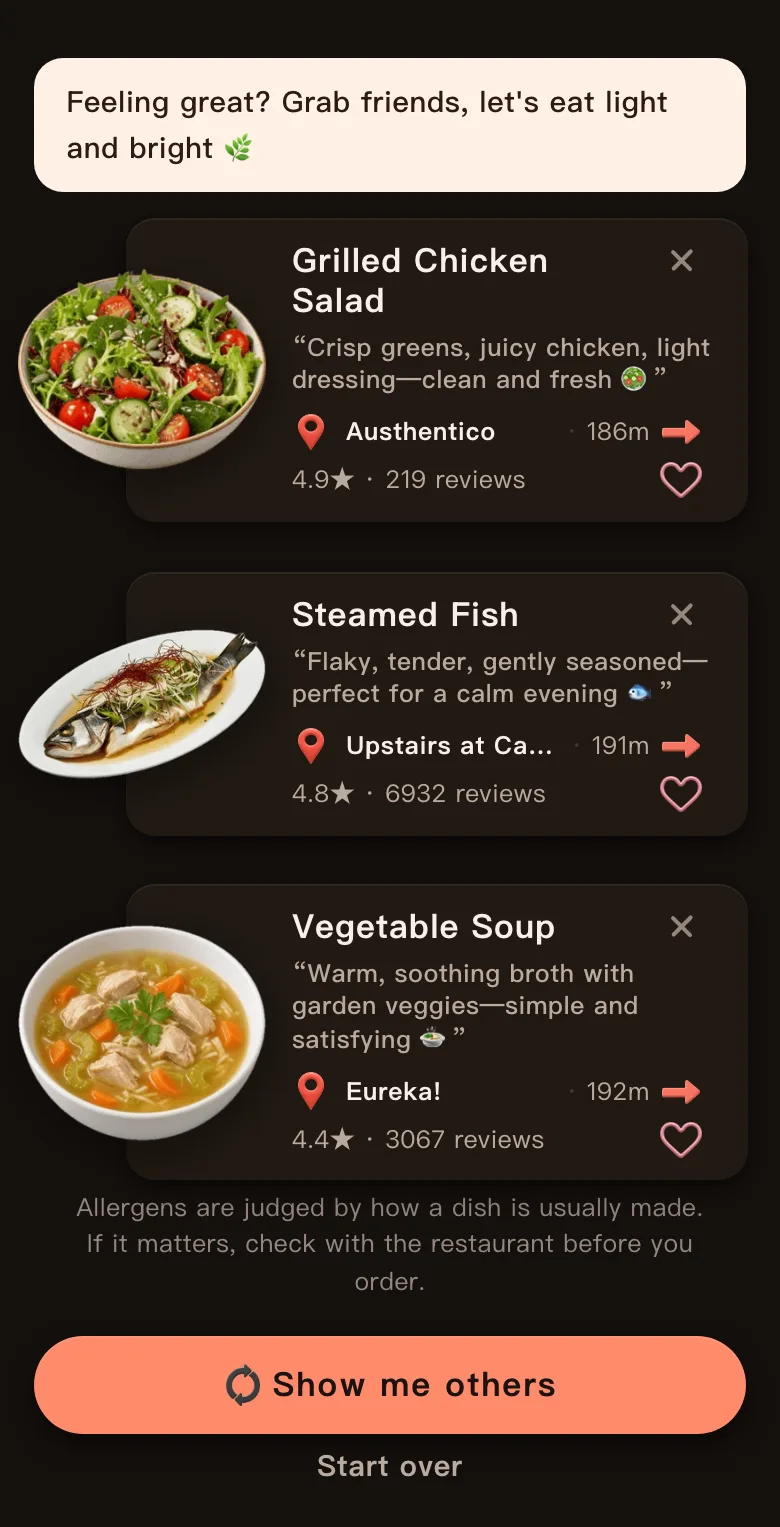
The cat’s greeting was “Feeling great? Grab friends, let’s eat light and bright”. Three cards sat under it, all within 192 m: a grilled chicken salad, steamed fish, and vegetable soup. A bowl of soup isn’t a group dinner to me, so as the picker I dropped it without asking anyone. I’d take the steamed fish, since a whole fish is easy to share, and tell the group once.
There was no vote. The two friends who skip nuts and beef had their say before the pick, and they said it as facts. The rest of this post walks through that run slowly.
How do you pick a restaurant for a group without a vote?
To pick a restaurant for a group, give one person the turn. Before they choose, everyone states fact objections only: what they can’t eat, can’t afford, can’t reach or can’t fit in. The picker chooses one place that clears them all, and next time the turn passes to someone else.
- Settle whose turn it is. The turn goes to whoever picked least recently. If nobody remembers, it goes to the person who suggested eating out.
- Collect the facts first. Each person says their fact objections before the picker looks at a single menu.
- Name one place. The picker says one restaurant, once. No shortlist goes up for a vote.
- Go, then pass the turn. Next time, someone else picks.
A vote asks everyone for a taste, and tastes split. The place that survives is often the one nobody minds and nobody wanted. The turn rule lets one person want something, and rotation means everyone gets that night sooner or later.
What counts as a fair objection to someone’s restaurant pick?
A fair objection is a fact that stays true whatever anyone’s mood. Think of a food someone doesn’t eat, a price they can’t pay, a distance they can’t travel, opening hours, or a time limit. “Not feeling it” is a taste, and under the turn rule tastes wait for your own turn.
The line between the two is easy to hear once you listen for it.
- “I don’t eat beef” is a fact. “I’m not in a beef mood” is a taste.
- “I have to leave by nine” is a fact. “That place always feels slow” is a taste.
- “It’s closed on Mondays” is a fact. “I’ve heard it’s overrated” is a taste.
Facts go in before the pick. If someone already keeps a list of hard no’s, like the one in the five-line brief, that list is their fact objections. After the pick, only a fact nobody knew counts, such as finding the place shut. In Austin the skips did this job. Nuts and Beef went into the app before it picked anything.
How does the picker choose a good restaurant for everyone?
A good restaurant for a group clears every fact objection, has a menu wide enough that each person can find a dish, and is somewhere the picker would gladly eat. Don’t choose a place you dislike just to please the table. Your turn should get you a meal you want too.
For one person, choosing the dish before the place works well, as the dish-first guide explains. A group rarely wants one dish, so the picker looks for range instead: a menu with a few sections, and a dish for the friend with the longest skip list.
If you hold the turn and draw a blank, hand the first step to Today’s Mealow. The app asks six questions: what cuisine, which meal, how you’re feeling, what flavor, who you’re with and where, and anything you skip. From your answers it picks 3 dishes from real places near you, each with a one-line reason. Tap “Show me others” for a new set. The web version is free, in English or Chinese, and there’s a WeChat Mini Program. In my Austin run, the app sorted out the facts. Choosing among the three was still my job.
What should I do when someone says “choose a restaurant for me”?
When someone says “choose a restaurant for me”, treat it as handing you the turn. Ask for their fact objections, then pick one place and name it. By asking you to choose, they’ve set aside taste objections for tonight, so a “hmm, not there” afterward doesn’t reopen the choice.
Say it kindly and out loud: “Sure. Anything you don’t eat, and how far will you go?” Their answer is the whole brief. If you’re the one asking, send your facts with the request: “Choose for me. No shellfish, and somewhere I can walk to.”
The picker still needs a way to find the place. On streets you know, name the first one that clears the facts. Somewhere new, a three-pin shortlist narrows the map before you choose.
What is restaurant roulette, and how do you make it fair?
Restaurant roulette means letting chance pick where you eat. You spin a wheel, draw a name from a hat or use a random picker, and agree beforehand to go wherever it lands. To keep it fair, every place in the draw must already clear the group’s fact objections, and the first result stands.
Think of roulette as a turn that nobody holds. Three rules keep it honest:
- One entry per person, so whoever types fastest can’t fill the wheel.
- Facts before the spin. Strike any entry that fails someone’s fact objection before it can win.
- One spin. With best of three, people keep spinning until their own entry comes up, and you’re back to a vote.
If the winning place was your entry, count it as your turn, so roulette nights still move the rotation along. No place in mind? Let the random restaurant generator draw a kind of restaurant, like a Greek taverna or a dumpling house. Then the group heads to the nearest one. Food roulette is the same game one level down, with the spin choosing a dish from a food wheel.

Your turn and no idea where? Tell the cat who you’re with and what the group skips, and it picks 3 dishes from real places near you.
Pick for my groupHow do you pick a restaurant for a first date?
For a first date, the person who asked holds the turn. Ask your date for fact objections in the invite itself, like what they don’t eat and how far they can get. Then pick a place where you can hear each other and the menu has range, and name it once.
Putting the question in the invite keeps it light: “Thursday? Anything you don’t eat?” That collects the fact objection early. A wide menu helps on a date too, because your date shouldn’t have to order around your choice.
Next time, offer the turn back. Taking turns on dates works the same way it does with friends, and it shows you each other’s places. Once you’re seated, the one-choice rule makes ordering quick.
What else do people ask about picking a restaurant?
Who should get the first turn to pick a restaurant?
In a group that has never taken turns, the first turn goes to whoever suggested eating out. After that, the turn goes to whoever picked least recently.
What if the restaurant someone picked turns out to be bad?
A bad meal still counts as that person’s turn, and it doesn’t cost them the next one. Blame makes people refuse the turn, and then the group is back to voting.
Can the picker choose their own favorite place?
The picker can choose a favorite place as long as it clears everyone’s fact objections. Since the turn rotates, the others get their favorites on their own nights.
What if one friend objects to every restaurant pick?
Ask the friend which fact rules the place out. If they can’t name one, the objection is a taste, and the pick stands. Offer them the next turn so their preference gets its own night.
Should couples take turns picking restaurants?
Couples can alternate the same way: one person picks, the other raises facts only, and the next meal out belongs to the other person.