Where Should I Eat Near Me? Try a Three-Pin Shortlist
In short
- To decide where to eat near you, build a three-pin shortlist instead of scrolling the whole map.
- Draw your circle with a boundary you can see, and set one deal-breaker the place must pass.
- Drop three pins: a here-only place, a sure thing and a wildcard.
- Run the regret test: go to the pin you’d be sorriest to have skipped.

You’re standing on a corner with a map app open, and every block around you is covered in pins. Some have stars, some have photos, and they all look about the same from here. Asking strangers online “where should I eat around here?” gets you a dozen answers and no decision.
What helps is a quick way to throw most of those pins out. The three-pin shortlist does that in four steps, and you can run it right there on the corner.
How do I decide where to eat near me?
To decide where to eat near you, build a three-pin shortlist. Draw a small circle on the map and set one deal-breaker. Drop three pins inside it: a here-only place, a sure thing and a wildcard. Then run the regret test and go wherever you’d be sorriest to have skipped.
- Draw your circle. Pick a boundary you can see on the map, like a main road, the river, the end of the market or the next train stop. Anything past it is off the list tonight, however good it looks.
- Set one deal-breaker. Name the one thing the place has to have: a seat at a counter, a kitchen still open after your show, room for a stroller, quiet enough to talk. Keep it to one, because stacking several puts you back to comparing everything.
- Drop three pins. Inside the circle, find three places that pass the deal-breaker, each a different kind. The here-only pin serves something you can’t easily get where you live. The sure thing serves food you know you like. The wildcard is something you’d never normally pick.
- Run the regret test. Ask which of the three you’d be sorriest to have skipped by tomorrow. Go there. If no answer comes, the pin nearest to where you’re standing wins.
The shortlist chooses a place and leaves the dish to you. If you’d rather settle the food first, the what-to-eat-today guide covers that order. You can still use the circle to find somewhere that serves it.
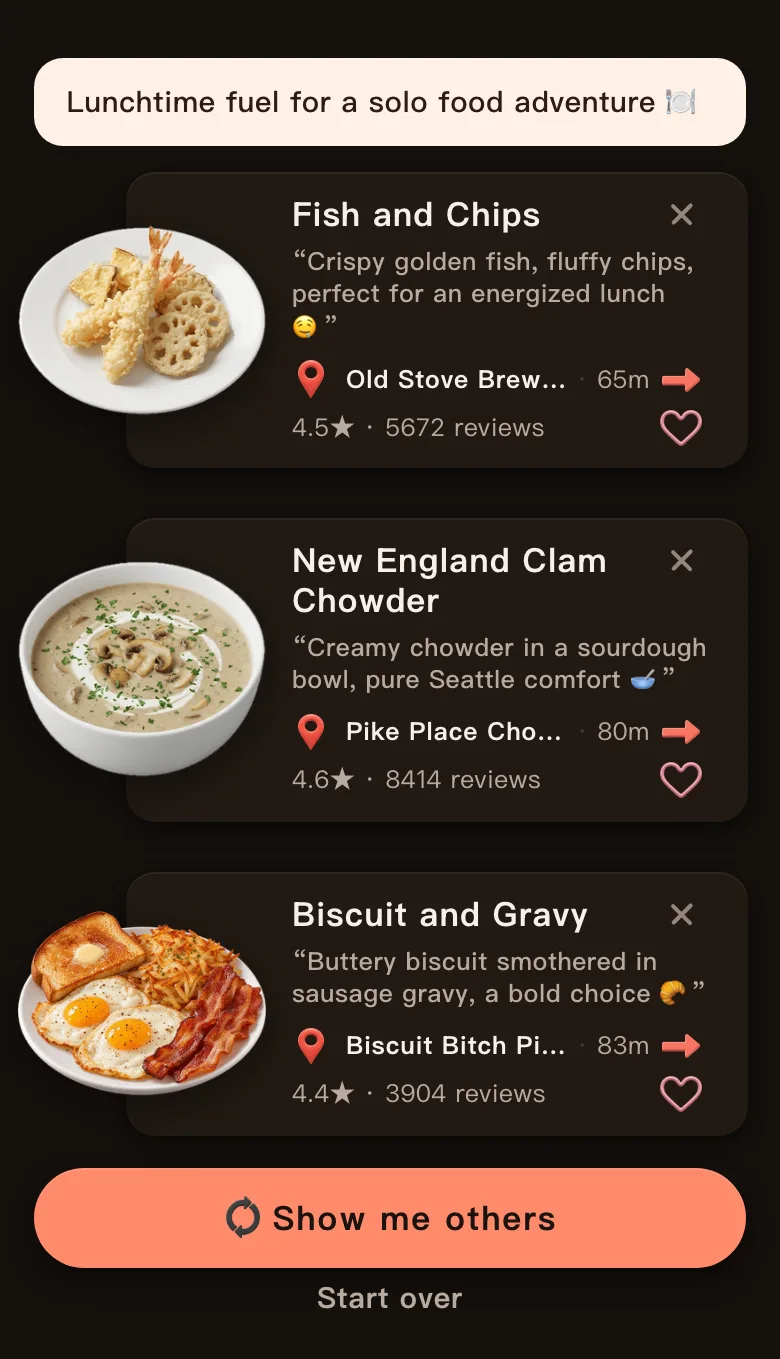
To check the shortlist against real places, I opened Today’s Mealow (I’m the one who builds it). I set the location to Pike Place Market in Seattle and played a solo luncher open to any cuisine. The cat replied “Lunchtime fuel for a solo food adventure” with fish and chips, a New England clam chowder and a biscuit and gravy, all within 83 m. That’s a three-pin shortlist already. The chowder card says “pure Seattle comfort”, so that’s the here-only pin. Fish and chips is the sure thing, and the biscuit is the wildcard. As a visitor, I’d be sorriest to skip the chowder.
How do I choose where to eat in a neighborhood I don’t know?
In a neighborhood you don’t know, draw the circle around where you’ll be next, not where you’re staying. Then give the here-only pin the most weight. On a trip, the meal you’d regret missing is usually the one you can’t have at home, and the regret test will lean that way.
It’s tempting to search around the hotel and then head somewhere else straight after. Center the circle on your next stop instead, whether that’s a museum, a show or a friend’s flat, and the meal happens on the way there.
If a local is around, skip the broad question. Ask “what’s the one thing around here I can’t get at home?” instead. That fills your here-only pin with something real. You still choose the sure thing and the wildcard yourself, so one person’s favorite doesn’t become your whole plan.
Where should I go eat when I’m bored of my usual places?
When you’re bored of your usual places, move the circle. Draw it around somewhere you go anyway but never eat, like the gym, a friend’s street or a train stop on the way home. Your usual spot can be the sure-thing pin, but it rarely wins the regret test.
That’s the useful part of the regret test at home. You never regret skipping your usual place, because it’ll be there next week. So the test leans toward the new pins without you having to force it.
The here-only pin changes meaning too. In your own city, it’s the place you’ve walked past a dozen times and never gone into. Put it on the list. If it’s still there after the regret test, that’s tonight.
Where should I eat for lunch near work?
For lunch near work, let your break draw the circle: only places you can walk to, eat at and walk back from in the time you have. Pick your three pins once, keep them as a standing rotation, and run the regret test only on days you want a change.
Weekday lunch is the same few blocks every day, so the shortlist doesn’t need rebuilding each time. Type your three pins, plus any extras that pass, into the lunch wheel and spin when you can’t be bothered to choose. For how big lunch should be, the afternoon-first lunch guide covers that side.

No time to drop pins? Today’s Mealow picks 3 dishes from real places near you, each with a one-line reason. Pick Lunch as the meal.
Find lunch near meWhat should an app to decide where to eat actually do?
An app to decide where to eat should know where you are, ask what rules places out for you, and hand back a short list rather than the whole map. A tool that picks a kind of restaurant leaves you to find the actual place yourself.
The random restaurant generator on this site works that way on purpose. It picks a type, such as a taqueria or a ramen shop, and you fill in the nearby place. That’s handy when you know the area and only need a nudge on the kind of food.
Today’s Mealow goes one step further and does the circle and the pins for you. It asks six questions: what cuisine, which meal, how you’re feeling, what flavor, who you’re with and where, and anything you skip. Then it picks 3 dishes from real places near you, each with a one-line reason. If none of the three wins the regret test, “Show me others” brings another set. It’s free in your browser, in English or Chinese, and there’s a WeChat Mini Program too.
What if none of the three pins feels right?
If none of the three pins feels right, change one thing and drop a fresh set. Widen the circle to the next boundary, or swap the deal-breaker for a different one. Don’t reopen the full map, since that puts you back on the corner scrolling.
Pay attention to why each pin lost. If all three were too far in practice, your circle was too big. If you kept thinking “too loud”, quiet was the real deal-breaker. Fix that one line and the next three pins tend to land better.
If every pin fails because no food at all sounds good, the map isn’t the problem. A veto round helps more on those days. And if someone else is choosing for you, they’ll need a quick brief before they pick.
What else do people ask about finding somewhere to eat nearby?
Where should I eat near me if I’m dining alone?
Eating alone, make the deal-breaker a seat that suits one person, such as a counter, a bar or a small table by the window. Then run the shortlist as usual. A solo meal is a good time to let the wildcard win.
How do we pick a place nearby as a group?
Agree on one deal-breaker together, then let three people each drop one pin. Everyone runs the regret test out loud, and the pin named most often wins. A tie goes to the nearest pin.
Should I trust star ratings when choosing a nearby restaurant?
Treat a rating as a floor. Decide the lowest rating you’d accept before you look, then ignore the small differences above it. Choose between the places that clear it with the regret test.
What if nothing near me is open?
When nothing inside the circle is open, widen it to the next boundary and make “open now” the deal-breaker. If you’re about to give up on going out, ordering in or eating at home is a fair answer.